

monarchs in England… You know… throughout history. The conquerors and the ones that
inherited all of their wealth and glory. I guess I plan to do both! –Siggie
Link to the Youtube video and the rest of the series!
Seventeenth episode of Siggie, presenting her take on the history of the monarchs of England in the context of her favorite topic….herself. This episode introduces the Stuart Dynasty, which began when King James VI of Scotland, the closest claimant to the English throne after the Virgin Queen Elizabeth I died, united the kingdoms of England and Scotland. James’ fear of witchcraft and his attempted assassination during the Gunpowder Plot are discussed. His son, Charles I, succeeded him but was executed as a result of the English Revolution, led by Oliver Cromwell. Charles I was the last English monarch to be executed.
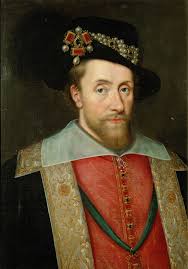
King James I. He was already King James VI of Scotland.
You’d think that that would be enough with his cup overflow-eth and he inherited
the English throne. So why did this happen? Simply because James was Queen
Elizabeth I’s closest eligible relative. James was the son of Mary Queen
of Scots. Elizabeth was actually kind of, sort of responsible for the execution of
Mary Queen of Scots but that’s a different story for a different day.
James became the King of England and the King of Ireland, and this was known as
the “Union of the Crowns” and James referred to himself as the King of Great
Britain. King James was also responsible for a new version of the Bible: The King
James Bible. How’s that for being original? This book is a reflection of the
intellectual that King James saw himself as. The book basically describes his
views on witchcraft, of which he had an intense fear, and his pathological
obsession led to the torture and death of thousands of people in Scotland.
It was not a good time to be a witch under the reign of this guy.
Scottish Parliament had actually made being a witch a capital offense right
before James’s birth. But James caused havoc and panic and destruction exactly
three decades later when he believed that his Danish bride Anne was being
targeted by witches. He had a pretty wild imagination… Then came the witch child,
perceived witchcraft conspiracies and all sorts of drama and chaos. Being a devout
Protestant, King James had Lunatic Fringe devout Catholics
trying to take him down. The goofball to end all goofballs was this guy named Guy
Fawkes, who with his Catholic cronies and conspirators tried to take James out in
the infamous failed Gunpowder Plot of 1605. This not a well executed plan to
explode the House of Lords and kill the king as the plotters were found out. Guy
Fawkes was hanged, drawn and quartered for his offense of high treason. And on Guy Fawkes Night,
his effigy is burned in a bonfire and there are fireworks. King James
died at the age of 58 in 1625.
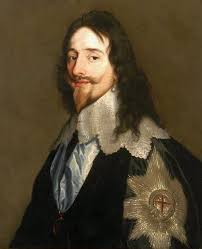
So King Charles I, he reigned for 23 years in the house of Stuart starting
with his daddy, King James I. And King Charles I’s reign ended
when Charles died in 1649 at the age of 48. Now when I say that Charles died, I
mean that he was beheaded. He was executed and what led up to this… Well,
let’s backtrack a bit shall we? Charles I was the King of England,
Scotland and Ireland. He was upsetting the church and the government by acting
like a Catholic. He married a Roman Catholic. He was also very unpopular
because of his policies such as the levying of taxes without Parliamentary
consent. This made him to be perceived as being tyrannical. And the whole marrying
a Catholic thing coupled with the- you know- lack of
support for Protestant forces during the 30 Years War. This led to hatred and
distrust among many of the English Puritans, among others. So there was a big
old civil war push-pull between the Protestants and the Catholics. Charles’s
royalist supporters, the Kings Cavaliers, ended up losing the English Civil War,
which put them up against Oliver Cromwell’s Parliamentarian Army.
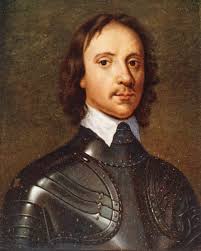
So who was this mysterious Oliver Cromwell? Well
he was an English Statesman. He was a politician and he was a soldier. He is a
very controversial figure because of his use of the army to gain power
politically. The brutality of his Parliamentarian conquest in Ireland. This
war led to famine, which was made worse by an outbreak of the Bubonic plague.
Lots of loss of life After Charles lost his head and the
monarchy was abolished, Cromwell became Lord Protector and he held this title
during England’s short period as a Republic. The monarchy was restored when
Charles’s son, Charles II, took the throne in 1660.
(Stay tuned for more of the Stuart Dynasty in episode 18…)